
Practical support to design, build, and roll out safe AI systems your teams will actually use.
AI adoption is a people challenge, not just a technical one. Many organisations have tried AI pilots, invested in tools, and trained teams, but don’t see lasting impact.
The typical pattern is lots of excitement, scattered experimentation, then tools sitting unused while work reverts to old patterns. This happens because implementation focuses on the technology rather than the human barriers to change.
Common blockers:
The result is lots of activity, but little that makes day-to-day work easier.
Kinhub’s role is straightforward: help you pick the right problems, implement solutions that work in your environment, and support rollout so people actually use them.
We help you pick the right problems, implement solutions that work in your environment, and support rollout so people actually use them. Our methodology combines technical implementation with behavioural change expertise—understanding both the technology and how people adopt new ways of working.
Unlike generic training or off-the-shelf courses that ignore how your teams actually operate, we design AI adoption programmes built for your real workflows and organisational context.
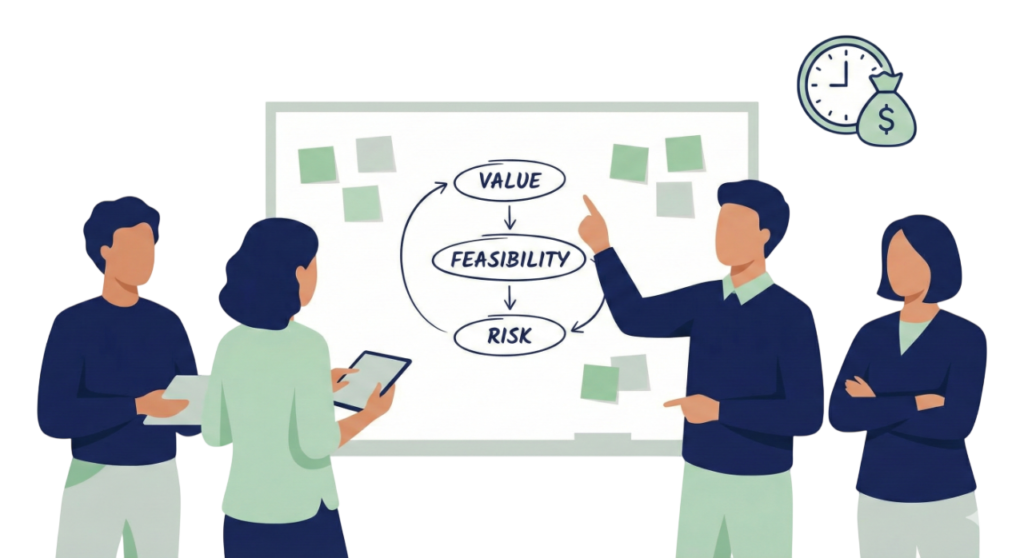
We run short sessions with stakeholders and frontline teams to identify where AI can save time or reduce errors. We then shortlist options based on:
You get a clear list of priorities and an implementation roadmap that focuses resources on high-impact opportunities.

We help implement AI features in the tools your teams already use (e.g., knowledge bases, ticketing systems, document workflows). Examples include:
We focus on reliability, clear limitations, and fallback processes, because AI only helps if teams trust it.

We help you set up practical safeguards, such as:
This is lightweight governance that enables delivery rather than stopping it.

AI only helps if people use it. We support:
Our approach moves teams from scattered pilots to coordinated capability that translates to measurable business impact.
Book an AI Implementation Audit (20 minutes)
We’ll review what you’ve tried so far, what’s blocking progress, and where you can get the fastest return. You’ll leave with clear next steps.
Behavioural science foundation: AI adoption requires understanding organisational psychology and change management, not just technical training. With expertise from LSE labour market research, University of Cambridge and KCL AI academic supervision, and an award-winning HR coaching practice, we understand how to move teams from experimentation to embedded capability.
Practical implementation: We’ve supported 50+ organisations through technology transformation, building automation and AI systems that integrate with real workflows—not theoretical ones. Our expertise spans CRM integration, workflow automation, and business process optimisation.
Production focus: We don’t just run pilots. We implement solutions that get to production and stay in production because teams actually use them.
No. We work with what you have and integrate where possible.
Sometimes, but often the best results come from applying existing models properly, with the right data access and safeguards.
We design around data minimisation, access controls, logging, and clear usage rules. We can work with your DPO/security team as part of implementation.
The aim is usually to reduce repetitive work and improve service quality, not to remove roles. The outcome is more capacity and faster turnaround.
Generic training focuses on what AI can do theoretically. We focus on what your team will actually do—designing adoption programs around real workflows, behavioural barriers, and organisational change. Our programs are grounded in behavioural science, not just prompt training.
This is exactly why our approach differs from standard implementation. We design rollout and training around how people actually change, with feedback loops and ongoing support to address real adoption barriers as they emerge. Tools are built for your workflows, not generic use cases.